
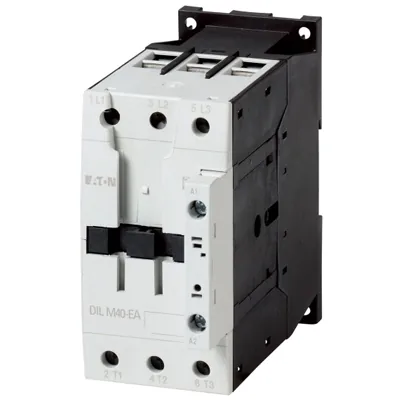
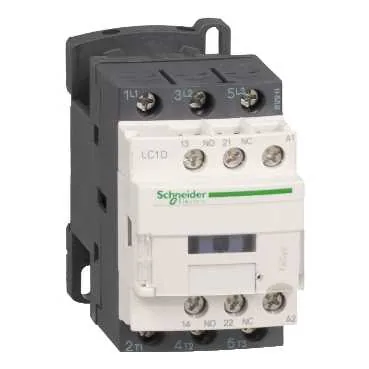
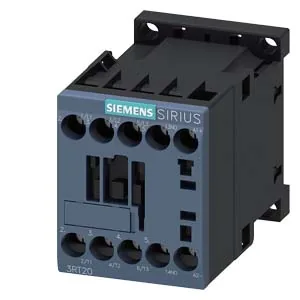
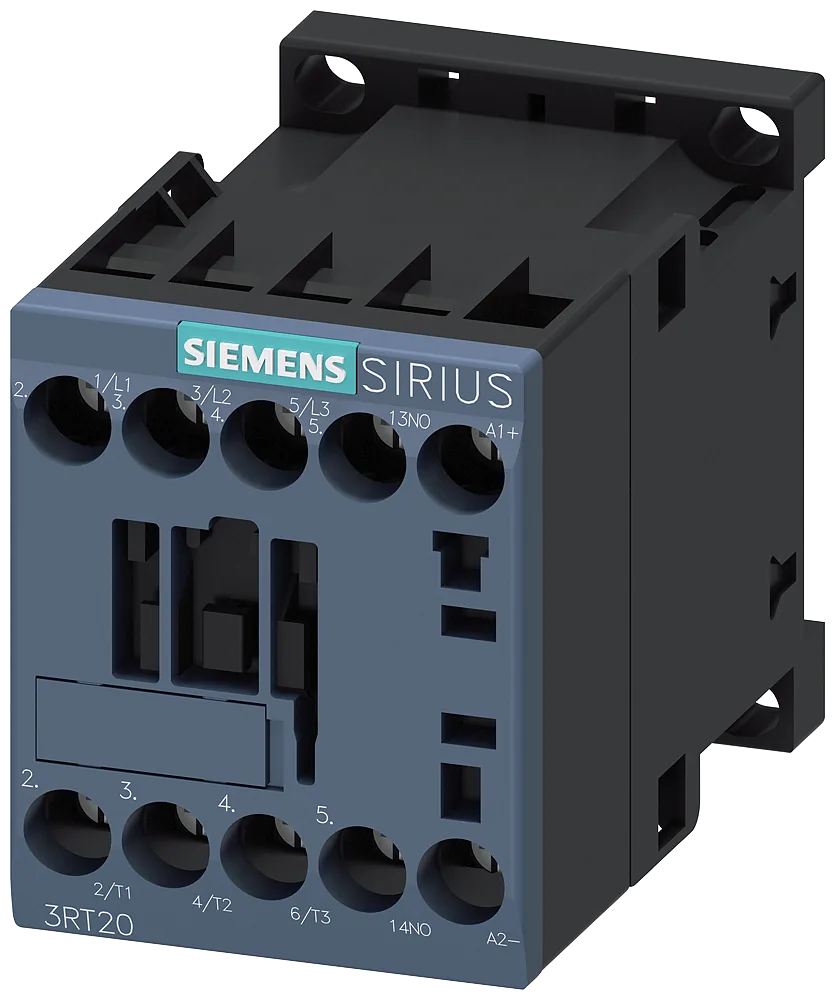
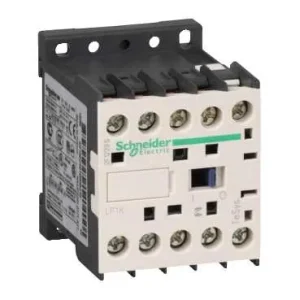
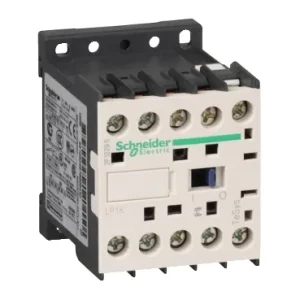
Siemens 3RT20 Power Contactor 9A 3NO+1NO 4 kW 24 V DC S00, Screw Terminals
31,08 € (25,27 € netto)
SIRIUS 3RT Contactors SIRIUS 3RT Contactors Safety you can afford Contactors for your applications Contactors for switching motors… and more SIRIUS 3RT is an extensive series of contactors, including 3-phase air-break and vacuum contactors for switching motors (AC-3/AC-3e), three- and four-pole contactors for switching resistive loads (AC-1), contactors for switching capacitors (AC-6b), 4-pole contactors for switching motors (AC-3), and many special versions that meet the requirements of any application. The 3RT series also includes a range of accessories…
Ships within 3–5 business days · delivery in approx. 5–7 business days
Description
SIRIUS 3RT Contactors
SIRIUS 3RT Contactors
Safety you can afford
Contactors for your applications
Contactors for switching
motors… and more
SIRIUS 3RT is an extensive series of contactors among which you will find 3-phase air-break and vacuum contactors for switching motors (AC-3/AC-3e), three- and four-pole contactors for switching resistive loads (AC-1), contactors for switching capacitors (AC-6b), 4-pole contactors for switching motors (AC-3), and many special versions that meet the requirements of any application.
The 3RT series also offers a range of accessories, wiring sets and mounting components that help reduce the risk of errors and speed up installation.
Discover SIRIUS 3RT contactors
Switching motors Utilisation category AC-3/AC-3e – switching squirrel-cage asynchronous motors is a task our contactors handle perfectly. A power range from 3 to 250 kW (at 400 V) for air-break contactors and up to 450 kW for vacuum contactors (3TF6 series) is sufficient for most applications. In addition to power, contactors are divided by mechanical sizes, the smallest being S00, i.e. 3RT201… with a power up to 7.5 kW, S0 (3RT202…) up to 18.5 kW, S2 (3RT203…) up to 37 kW… and larger ones, perfectly matching other devices in the SIRIUS series to create reliable starter combinations.
Switching resistive loads Utilisation category AC-1 – switching resistive loads. Contactors optimised for this purpose are available in three-pole and four-pole versions. Three-pole versions have a maximum load capacity of 2650 A, four-pole versions 525 A.
Switching capacitors Utilisation category AC-6b – switching capacitors. A special contactor design fitted with a block that limits the inrush currents associated with switching capacitors used in reactive power compensation banks. The 3RT26 contactor series is available for capacitors with a power up to 100 kVAr at 400 V.
Auxiliary contactors The 3RH2 series is at first glance identical to the 3RT202 contactors (i.e. mechanical size S00). As standard fitted with 4 contacts in combinations from 4NO to 2NO + 2NC, also available in an 8-contact version with removable contacts as well as permanently fixed ones (with SUVA certification).
Implementing safety functions Each of the contactors can be used to implement safety functions. Auxiliary contacts used in the feedback circuit comply with EN 60947-4-1 Annex F. Versions with a permanently mounted auxiliary contact block, i.e. those with SUVA certification, are also available. An innovation is the contactor with F-PLC-IN input; a special coil design allows SIL 2 level to be achieved using only one contactor.
Starter combinations Available as ready-made sets or as individual components. In the SIRIUS switching device portfolio you can find sets for reversing starters and star-delta starters. These sets can be easily fitted with short-circuit protection (e.g. SIRIUS 3RV2 motor starter protector) and mounted on a mounting plate or using dedicated adapters on a 60 mm distribution busbar system. They can also be installed in the SIRIUS 3RV29 mounting system.
Accessories Among the accessories you will find the most commonly used ones: surge suppressors installed in the coil circuit, auxiliary contact blocks mounted on the front or side, sets for building reversing or star-delta circuits. There are also less popular but often very useful elements, including: time-delay modules, mechanical interlock modules, coupling modules and communication-version function modules.
Discover the benefits of using 3RT contactors
Screw or spring-type connections
Devices and accessories are available in versions with screw or spring terminals. Spring terminals for current paths are available for devices up to size 18.5 kW (38 A for AC-3).
Spare parts
Hundreds of thousands of switching cycles lead to wear of contacts and arc chutes. This is not a problem. Coils, contacts, arc chutes – allow further operation of the devices without the need to replace them.
Machine safety
It’s no problem – with SIRIUS 3RT contactors you can achieve PL c / SIL 1 using a single device. Two contactors allow you to achieve up to PL e / SIL 3. No special versions are required. The exception is the contactor fitted with a special coil with F-PLC-IN input, which allows SIL 2 to be achieved using only one contactor in the current path.
Compatibility with other devices
SIRIUS components have been designed to work together as seamlessly as possible. The same applies in this case. Contactors can be easily combined with 3RT series circuit breakers, overload relays, 3RR relays and other devices from the SIRIUS group.
Screw
or spring terminals
Spare
parts
Machine
safety
Compatibility with other
devices
See what questions other users have had
Mirror contacts, contacts with forced guidance?
Appropriate contact design is required, for example, when a device is used in a safety circuit. Mirror contacts according to EN 60947-4-1 Annex F and mechanically linked contacts according to EN 60947-5-1 Annex L, in short, assume that an NC contact should not close while the NO contact or current path is not open.
Is a surge suppressor needed for the coil?
Surges are generated when the coil is switched off; the coil can be equipped with an additional element (e.g. varistor, RC circuit, diode) to limit the value of this surge. The suppressor also affects the opening time of the contactor contacts. The use of a suppressor results, among other things, from standards relating to electromagnetic compatibility. It should be noted that a large proportion of coils have this type of element built in at the factory.
Coordination type 1 or 2?
Does it even matter?
Coordination type describes the behaviour of a starter combination in the event of a short circuit. In coordination type 1, damage to the device is permitted. Coordination type 2 requires that the devices remain operational afterwards. It is important that the offered device combinations are properly tested to ensure long and safe operation.
Utilisation category – what does it define?
Utilisation category (e.g. AC-3, AC-4) defines the conditions related to switching the load and arise directly from its characteristics. When selecting a device, special attention should be paid to the currents that the device can switch for a given load type. Improper selection may result in faster wear of the device.
SIRIUS Industrial Switching Devices
Technical Data – AC Contactor
| Rated operational power for AC-3, 400 V | 4 kW |
| Number of main NO contacts | 3 |
| Number of NO auxiliary contacts | 1 |
| Rated Operating Current Ie for AC-3, 400 V | 9 A |
| Rated Operational Current Ie for AC-1, 400 V | 22 A |
| Rated control voltage Us for DC | 24 V |
| Main contact connection type | Screw Connection |
| Control Voltage Type | DC |
| Rated Operational Current for AC-4, 400 V | 8.5 A |
| NEMA Rated Operational Power | 3.67749 kW |
Safety instructions: hilark.eu/gpsr/en.
Additional information
| Weight | 0,02 kg |
|---|---|
| Dimensions | 5 × 4 × 3 cm |
| Brand | Siemens |
Reviews
There are no reviews yet.